9 Dec 2009


ART NOUVEAU

Art Nouveau (1890 - 1905) was an art movement that peaked at the beginning of the 20th Century. An international movement, style of art and applied art, Art Noueveau, also known as Jugendstil was characterized by organic, floral and other plant inspired motifs, as well as highly detailed curvilinear forms.


Here is an example of Art Nouveau decoration:


Staircase of the Maison and Atelier of Victor Horta. This building is one of four Horta-designed town houses in Brussels that are together recognised by UNESCO as "representing the highest expression of the influential Art Nouveau style in art and architecture." (source: http://en.wikipedia.org/wiki/Art_Nouveau)


Having a strong influence throughout Europe, Art Nouveaus fifteen year peak ended in 1905.


Examples of Art Nouveau style patterns:


Although Art Nouveau fell out of favor with the arrival of 20th-century modernist styles, it is seen today as an important bridge between the historicism of Neoclassicism and modernism

8 Dec 2009


IMPRESSIONISM


Impressionism was an art movement that began in the 19th Century and gained significance in the 1870s and 1880s. The name of the movement came from a piece of art created by Claude Monet called Impression, Sunrise.


Claude Monet, Impression, Sunrise (Impression, Sunrise), 1872, oil on canvas, Musee Marmottan


Characteristics of Impressionist paintings include visible brush strokes, open composition, emphasis on light in its changing qualities (often accentuating the effects of the passage of time), ordinary subject matter, the inclusion of movement as a crucial element of human perception and experience, and unusual visual angles. The emergence of Impressionism in the visual arts was soon followed by analogous movements in other media which became known as Impressionist music and Impressionist literature.
Impressionism also describes art created in this style, but outside of the late 19th century time period.


On the Bank of the Seine, Bennecourt (1868), Claude Monet


Impressionist art is a style in which the artist captures the image of an object as someone would see it if they just caught a glimpse of it. They paint the pictures with a lot of color and most of their pictures are outdoor scenes. Their pictures are very bright and vibrant. The artists like to capture their images without detail but with bold colors. Some of the greatest impressionist artists were Edouard Manet, Camille Pissaro, Edgar Degas, Alfred Sisley, Claude Monet, Berthe Morisot and Pierre Auguste Renoir.
While the term Impressionist covers much of the art of this time, there were smaller movements within it, such as Pointillism, Art Nouveau and Fauvism.

26 Nov 2009

Dada


DADA

Dada is a movement that peaked between 1916 - 1922 and mainly involved visual arts, literature, poetry and graphic designs. Beginning in Germany in 1916, it was a collaberation between artists of several nations, including Germany, France and Switzerland. It was seen as an anti war movement and the early Dada works produced were of protest art. The movement chose the name “Dada” by inserting a slip of paper into a French dictionary and choosing the word it landed on, which happens to mean a hobbyhorse or child's toy.


The image above is called Cut with the Dada Kitchen Knife through the Last Weimar Beer-Belly Cultural Epoch by Hannah Hoch. in Germany, 1919.
According to its proponents, Dada was not art, it was "anti-art." For everything that art stood for, Dada was to represent the opposite. Where art was concerned with traditional aesthetics, Dada ignored aesthetics. If art was to appeal to sensibilities, Dada was intended to offend. Through their rejection of traditional culture and aesthetics, the Dadaists hoped to destroy traditional culture and aesthetics.

19 Nov 2009

FUTURISM


FUTURISM (1909 - 1914)

Futurism was a social and artistic movement started in Italy in the early 20th Century Italy. It was largely an Italian phenomenon, and then western Europe started to take notice in the movement.

The Futurists practiced in every medium of art:
  • Painting
  • Sculpture
  • Ceramics
  • Graphic Design
  • Industrial Design
  • Interior Design
  • Theatre
  • Film
  • Fashion
  • Textiles
  • Literature
  • Music
  • Architecture
  • Gastronomy
The Futurists admired speed, technology, youth, violence, the airplane, the car and the industrial city. The Futurists wanted to represent the technological triumph of humanity over nature, and they did. They were passionate nationalists.


Nikolay Diulgheroff was a Futurist artist who produced many paintings, along with the one on the right.

This painting, called L'uomo razionale, created in 1928 was painted by Diulgheroff and you can tell that it was a product of Futurism as the shapes look like metal squares and objects which you would see in an industrial area.

This is further evident in the use of colour. In my opinion, I believe Diulgheroff used the grey colours to represent the industrial times as metal's usual coulor is grey.

12 Nov 2009

Surrealism

SURREALISM

Surrealism is an artistic movement and philosophy that first gained popularity in the 1920s. Initially, surrealism was an offshoot of Dadaism, which posited that traditional art should be replaced with anything "anti-art" and triumphed the ridiculous, the absurd, and a basic disregard for form. Andre Breton was the initial proponent of surrealism in literature and the visual arts. Much of his emphasis was on accessing the unconscious, as viewed by psychiatrist Sigmund Freud. Surrealism was a reaction to the philosophy of rationalism, which many felt had caused, through the Industrial Revolution, the disaster of World War I.(source: http://www.wisegeek.com/what-is-surrealism.htm)

The picture on the right is called The Persistence Of Memory, created by Salvadore Dali, 1931. I can see why this is one of his most famous works because I believe that the melted clocks represent long time memory. The melted clocks are like persistent memories because the clocks are still there but they are melting like a persistent yet fading memory.


Rene Magritte, another artist created this picture below. Called
Les Amants [The lovers], it depicts two people in love both wearing blankets over their heads. Magriite could be suggesting that looks do not matter when it comes to love in a very surreal way by drawing blankets over their heads, making them not being able to see each other.
This painting was created in 1928.

5 Nov 2009

Abstract Art

Abstract Art

Abstract art uses a visual language of form, color and line to create a composition which may exist with a degree of independence from visual references in the world. Abstraction indicates a piece of reality in depiction of imagery in art. This piece of accurate representation can be slight, or partial or complete.

The several artists below are Abstract Artists:

Piet Mondrian, born 1872, was a Dutch painter. He was an important contributor to the De Stijl art movement and group. Mondrian painted a piece called View From The Dunes with Beach and Piers.

This image was painted in 1909 and depicts a simplistic version of seascape and sky. He has used various tones of orange to portray the sky and grey and white to portray the sky.

What makes this painting abstract is the the simplistic view created in this drawing from what he saw. Without truely studying the picture, it is hard to know what this painting is meant to look like. But after looking at it for a while, lines and colours start to form making it recognisable without having to look at the name of the painting first to see what it is.
The mixture of what appears to be blue and light light orange makes the water recognisable along with the heavy use of orange and dark orange to represent the beach on the left. On the right of the painting, we see a usage of light brown which at first sight looks like unused land, but once you do take a look at the name of the painting, you'll start to realize that the brown is actually a pier.
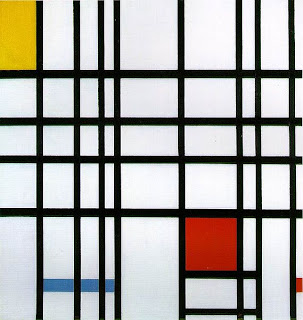


In this image, called Composition with Yellow, Blue, and Red, the lines represent streets from obviously a birds eye view of the streets of New York City. This painting is very abstract because there are no objects to represent any landmark or building within New York, or anywhere else for that matter of fact, and all we are left with are reasonably thick black lines which intersect each other in straight, often close lines which represent streets.

This painting was also created by Piet Mondrian in 1937-42.

22 Oct 2009

ART DECO

Art Deco

From 1925 until the 1940s, Art Deco was a popular international art design movement affecting the decorative arts such as architecture, interior design, and industrial design, as well as the visual arts including painting, the graphic arts, fashion and film. At the time, this style was seen as elegant, glamorous, functional, and modern. The movement was a mixture of many different styles and movement of the early 20th century,including Neoclassical, Constructivism, Cubism, Modernism and Futurism. The movement was a mixture of many different styles and movements of the early 20th century, including Neoclassical, Constructivism, Cubism, Modernism, Art Nouveau and Futurism.

It is characterized by the use of angular, symmetrical geometric forms. One of the classic Art Deco themes is that of 1930s-era skyscrapers such as New York's Chrysler Building and Empire State Building.

Another of many many Art Deco buildings is the City Hall of Buffalo. When approaching City Hall from Niagara Street, one is impressed with an architectural style which is modern without being modernistic and which depicts the age in which it was built. Also, it generally balanced its modernism with a taste of the symbolism normally associated with classical architecture.
The 32 story Art Deco building was completed in 1931 by Dietel, Wade & Jones.